
 Available in US
Odds are not just numbers on a screen. They are the collective weight of millions of dollars, thousands of opinions, and decades of historical data compressed into a single decimal figure. When the market prices Argentina at 5.00 to win the 2026 World Cup, it is not an arbitrary figure — it is a crowd-sourced probability assessment that tells you exactly what the betting public believes will happen in North America this June.
I have spent the last nine years interpreting World Cup 2026 odds and building predictive models around them, and the truth is that the market gets it right more often than most pundits. But “more often than most” is not “always,” and the gaps between market pricing and reality are where profitable bets live. This page breaks down the outright winner market, the group-by-group odds, the dark horse candidates the market may be undervaluing, and the All Whites’ pricing — because if you are reading this from New Zealand, that is the chapter you are here for.
Every number in this analysis reflects pre-tournament pricing. Odds will shift as we approach kickoff, and they will move again once the ball starts rolling. The time to find value is now, before the market corrects itself.
Argentina sit at the summit of the outright market, and the price — around 5.00 on TAB NZ — reflects their status as defending champions. But here is the complication: no team has won back-to-back World Cups since Brazil in 1958 and 1962. Italy failed in 2010, Germany failed spectacularly in 2018, and history suggests that the weight of defending a title in a tournament this intense is nearly impossible to carry. Lionel Messi will be 39 in June, and while his competitive fire remains undimmed, the physical demands of seven knockout matches in North American summer heat are a legitimate concern. Argentina’s depth — Julián Álvarez, Enzo Fernández, Alexis Mac Allister — keeps them at the top, but I believe the market is slightly overpricing their chances based on the emotional residue of Qatar 2022.
France are typically priced between 5.50 and 6.50, and on pure squad talent, they may be the strongest team in the field. Kylian Mbappé is the best player in the world on his day, and the supporting cast — Aurélien Tchouaméni, Eduardo Camavinga, William Saliba — is absurdly deep. France reached the final in 2022 and won it all in 2018, making them the most consistent World Cup performer of the last decade. My concern with France is managerial. Didier Deschamps has been in charge since 2012, and there are signs of tactical stagnation. A squad this talented should dominate matches, but France often grind through tournaments rather than dazzle. At 6.00, I think they represent fair value rather than genuine value.
Brazil’s price sits around 7.00, and the narrative is irresistible: the five-time champions have not won a World Cup since 2002. That is 24 years without the trophy, the longest drought in Brazilian football history. Vinícius Júnior has matured into a Ballon d’Or contender, Endrick adds youthful explosiveness, and Rodrygo provides creativity from multiple positions. The squad is talented enough to win the tournament. The question — and it is the same question every four years — is whether Brazilian flair can coexist with the discipline required to survive seven knockout matches. Their CONMEBOL qualifying campaign was rocky, with away defeats that raised questions about defensive organisation. At 7.00, I see value if you believe the attacking talent will overwhelm opponents, but I see risk if you need defensive solidity.
England enter at roughly 8.00, and the narrative writes itself: 1966 was 60 years ago, and this golden generation — Jude Bellingham, Bukayo Saka, Phil Foden, Declan Rice — is running out of time to deliver on its promise. England reached the final of Euro 2024, lost to Spain, and the pattern of near-misses is becoming a defining characteristic. The squad is undeniably talented, and the appointment of a new manager after Gareth Southgate’s departure may have unlocked tactical flexibility that was missing. England at 8.00 is a price I find interesting because the talent is top-three in the tournament but the market prices them lower due to historical underperformance.
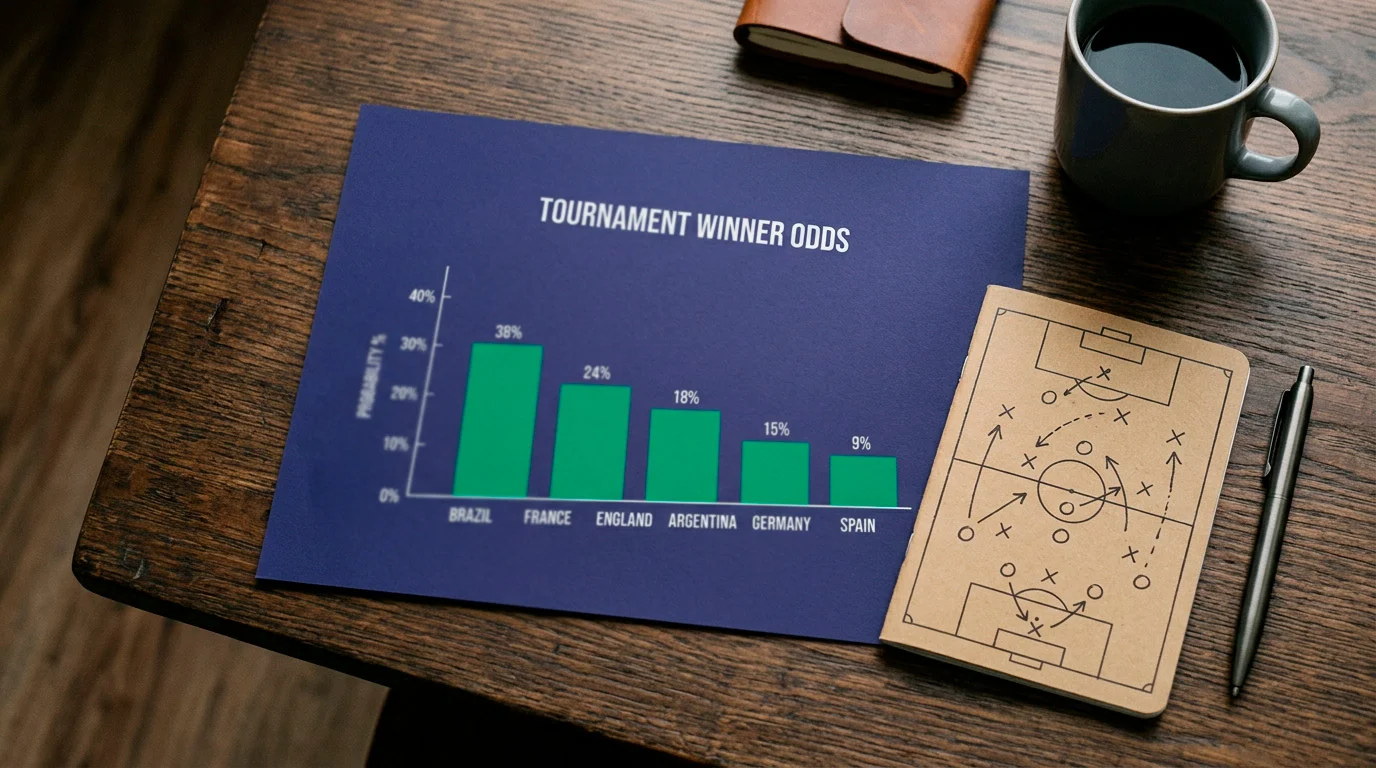
Spain are the European champions and, in my assessment, the best value in the top five at around 8.50. The team that won Euro 2024 did so with a squad whose average age was the youngest in the tournament. Lamine Yamal was 16 during that run; he will be 18 at the World Cup. Pedri, Gavi, and Nico Williams form a midfield and forward line that combines technical excellence with relentless energy. Luis de la Fuente’s side play with a fearlessness that older squads cannot replicate, and the fact that they enter as European champions but are priced behind three other teams tells me the market is lagging behind the reality of this squad’s trajectory.
Germany at approximately 10.00 are rebuilding after the disappointment of hosting Euro 2024 and exiting to Spain in the quarter-finals. Florian Wirtz and Jamal Musiala are generational talents, and if the rest of the squad clicks, Germany have the upside to challenge anyone. But “if the rest clicks” is doing a lot of work in that sentence. At 10.00, you are paying for potential rather than proven consistency, and I prefer to wait and see how their pre-tournament form develops before committing.
Portugal, the Netherlands, Belgium, and Uruguay round out the top ten in most outright markets. Portugal rely heavily on the Cristiano Ronaldo question — whether he plays, in what role, and how the team dynamic functions around a 41-year-old icon. The Netherlands have a solid but unspectacular squad that grinds rather than dazzles. Belgium’s golden generation — Kevin De Bruyne, Romelu Lukaku — is ageing, and their price around 17.00 reflects the uncertainty of a team in transition. Uruguay under Marcelo Bielsa play beautiful, aggressive football, but their squad depth is thinner than the South American heavyweights. Each of these teams has a story, and each story is worth a bet if the price is right — but none of them offers the same quality-to-price ratio that Spain does in my model.
Morocco at 26.00 is the number that keeps pulling me back to my spreadsheet. This is a team that reached the semi-finals in 2022 — the first African nation to do so — and they did not do it with luck. They beat Belgium, Spain, and Portugal in the knockout rounds with a defensive structure that was the best in the tournament. Two and a half years later, Walid Regragui still has that defensive core, and the squad has gained European club experience across the board. The market is pricing Morocco as a fringe contender, but their 2022 run was not a fluke. Group C alongside Brazil is tough, but reaching the knockouts is a realistic floor, and from there, their ceiling has already been demonstrated on the world stage.
Japan have been the most improved footballing nation of the last decade, and their price around 34.00 feels like the market has not caught up. They beat Germany and Spain in the 2022 group stage — not scrappy wins but tactically executed performances that left both European sides bewildered. The Japanese league has grown stronger, more players are competing in Europe’s top five leagues, and the national team’s pressing style under Hajime Moriyasu is among the most intense in international football. Group F with the Netherlands, Tunisia, and a UEFA playoff winner is navigable, and the knockout bracket from that side could be favourable.
Colombia at 29.00 bring the flair and the firepower. Their 2024 Copa América run — reaching the final before losing to Argentina — showed that this group of players can compete at the highest level of South American football. Luis Díaz is one of the most exciting wingers in the world, and the midfield combination of James Rodríguez’s guile and younger legs around him creates a blend of experience and energy. Colombia’s group — K, alongside Portugal, Uzbekistan, and an intercontinental playoff winner — has a clear favourite in Portugal, but second place is there for the taking.
Croatia at around 40.00 may seem generous for a team that reached the 2018 final and finished third in 2022, but the market is adjusting for age. Luka Modrić will be 40. The squad is transitioning, and Group L with England, Panama, and Ghana is not easy. Still, Croatia have a World Cup pedigree that defies their population of four million, and underestimating them in tournament settings has cost punters dearly in the past. I would not back Croatia to win the whole thing, but the “to reach the quarter-finals” market at enhanced odds is a bet that interests me.
Senegal complete my second-tier watchlist. Africa Cup of Nations champions, blessed with European-based talent in every position, and drawn into Group I with France, Norway, and a playoff winner. Senegal are unlikely to beat France, but if they take maximum points from the other two matches, a second-place finish or a strong third-place run is well within reach. At 80.00 for the outright, Senegal are a speculative flutter, but their group-stage prices offer more realistic value.
Group winner markets are where I make the bulk of my pre-tournament bets, and the reason is straightforward: you are predicting the outcome of three matches, not seven. The sample is small enough that one well-researched insight — a tactical mismatch, a scheduling advantage, a squad rotation pattern — can give you a genuine edge over the market. The full groups and draw analysis covers the structural detail behind each group. Here is my read on all twelve from a pricing perspective.
Group A opens the tournament in Mexico City, and the host nation is the clear favourite to top it. Mexico at home in Estadio Azteca is a different proposition to Mexico on the road, and their group — South Korea, South Africa, and a UEFA playoff winner — is manageable. South Korea are the danger team, with Son Heung-min still capable of individual brilliance, but Mexico’s home advantage and crowd energy should carry them through. Mexico to top the group at around 1.90 is close to fair value.
Group B hinges on the UEFA Playoff A winner. If Italy come through that playoff, the group becomes fiercely competitive alongside Switzerland and Canada. If Northern Ireland or Bosnia qualify instead, Canada become strong favourites to top the group on home soil. I am waiting for the playoff results before committing to Group B, and I suggest you do the same. Betting on incomplete information is not strategy — it is guessing.
Group C is headlined by Brazil and Morocco, and this is the group where I see the most value in the “group winner” market. Brazil are priced as heavy favourites at around 1.50, but Morocco’s defensive record in 2022 and their continued improvement since then make them a legitimate threat to top the group. Brazil’s CONMEBOL qualifying form was inconsistent, with defeats to Uruguay and Colombia that exposed defensive frailties. Morocco to top Group C at 4.50 is a price I have already noted in my pre-tournament betting list.
Group D features the USA at home, and the market has them as comfortable favourites. Paraguay and Australia are solid but limited sides, and the playoff winner rounds out the group. The USA’s home advantage across all three matches is a significant factor, but home-nation pressure in the opening match is a real psychological variable. I expect the USA to qualify comfortably but would not rush to back them as group winners at odds shorter than 1.70.
Group E gives Germany a favourable draw alongside Côte d’Ivoire, Ecuador, and Curaçao. Germany should top this group, and the price around 1.45 reflects that. The value here is thin. Côte d’Ivoire, the reigning Africa Cup of Nations hosts and champions, are the team most likely to push Germany, but their European club representation is thinner than Morocco’s or Senegal’s. I am passing on Group E.
Group F pairs the Netherlands with Japan, Tunisia, and a UEFA playoff winner. This is one of the most interesting groups for betting because the Netherlands and Japan are closely matched, and the market may be overvaluing European pedigree. Japan beat Germany and Spain in 2022 group matches, and their pressing game is ideally suited to dismantling teams that play with a high defensive line. Netherlands to top the group at 1.60 feels too short given Japan’s trajectory. Japan at 3.50 to top Group F is a bet I am seriously considering.
Group G is the one every Kiwi punter wants to hear about, and I cover it extensively in the All Whites section below. Belgium are favourites, Egypt are second favourites, and New Zealand are the outsiders — though the Iran situation adds a layer of uncertainty that the market has not fully resolved.
Group H puts Spain alongside Uruguay, Saudi Arabia, and Cabo Verde. Spain should dominate, and the price reflects it. Uruguay are the clear second-place finishers on paper. The value play in Group H is Uruguay to top the group at around 4.00 — unlikely but not impossible if Spain rotate their squad for matchday three with qualification already secured.
Group I features France with Senegal, Norway, and a playoff winner. France to top the group at 1.35 offers no value whatsoever. Senegal to finish second is the more interesting angle, priced around 2.80, especially if the playoff winner turns out to be a weaker side.
Group J draws Argentina with Algeria, Austria, and Jordan. Argentina should cruise through, and the market agrees with odds around 1.30 to top the group. Algeria are the second-best team on paper, but Austria’s structured approach under Ralf Rangnick could spring a surprise. There is not enough value here for me to invest.
Group K puts Portugal and Colombia together — two top-20 sides with genuine quality. This is the group I expect to produce the most betting drama. Portugal at 1.55 and Colombia at 2.80 to top the group are both prices that could go either way, and the volatility means live betting during matchday two and three will be frantic. My pre-tournament lean is Colombia to top the group, based on the theory that Portugal’s squad harmony is more fragile than the market assumes.
Group L gives England a path alongside Croatia, Panama, and Ghana. England to top at 1.50 is fair, and Croatia at 3.80 to top it represents their pedigree. I favour England here, but the margin between these two sides is narrower than the pricing suggests. A Croatia upset in the direct match would flip the group entirely.
I was 14 when the All Whites drew 1-1 with Italy at the 2010 World Cup in South Africa. I remember my dad leaping off the couch, I remember the neighbours shouting, and I remember thinking that football in New Zealand would never be the same. It was not — but not in the way I hoped. It took 16 years for the All Whites to return to the World Cup, and now that they are in Group G alongside Belgium, Egypt, and Iran, every Kiwi punter wants to know: what do the odds actually say?
The outright odds for New Zealand to win the 2026 World Cup sit around 500.00 — a price that implies a 0.2% chance. That is not a bet I recommend to anyone, because the probability of a team ranked in the 90s winning seven consecutive knockout matches against the world’s best is vanishingly small, regardless of heart or home support. Where the All Whites odds become interesting is in the group-stage and qualification markets.
New Zealand to qualify for the round of 32 is priced at approximately 5.00, implying a 20% probability. I believe the true probability is closer to 30%, and here is why. The third-place qualification route means the All Whites do not need to finish above Belgium or Egypt — they need to finish above the weakest four third-placed teams across all twelve groups. If New Zealand collect three or four points from their three matches — one draw and one upset, or two draws — their goal difference only needs to be competitive with other third-placed finishers from groups where the gap between second and third is wider. Groups containing a clear top two (like Group E with Germany, or Group J with Argentina) will produce third-placed teams with very few points, dragging the qualification threshold down.
The match-level markets tell a more granular story. New Zealand’s first match against Iran at SoFi Stadium in Los Angeles is complicated by the uncertainty over Iran’s participation. If Iran withdraw or are replaced, the market will reprice entirely — a replacement team like the UAE or Iraq would likely be weaker than Iran, boosting New Zealand’s chances in that opening fixture. If Iran do play, the match is priced as a near-coinflip, with Iran slight favourites at around 2.60 and New Zealand at 3.00. The draw sits around 3.10. In a match between two teams ranked closely together, I lean towards the draw market because both sides will prioritise not losing their opening game.
New Zealand versus Egypt in Vancouver is the match I have circled as the key to the group. Egypt, led by Mohamed Salah, are stronger on paper, and the market reflects that with Egypt at around 1.90 and New Zealand at 4.50. But Vancouver is the closest World Cup venue to New Zealand, and the Kiwi contingent travelling to BC Place will create an atmosphere that punches above its weight. If the All Whites can frustrate Egypt’s attack and take a point from this match, the third-place route opens up completely.
The Belgium match on matchday three is the one I expect New Zealand to lose. Belgium’s quality — even in a transitional squad — is a tier above, and the odds of around 1.35 for a Belgian win reflect that reality. The betting angle here is not the match result but the handicap market: New Zealand +1.5 at around 1.80 asks whether the All Whites can keep it to a one-goal defeat, and based on their defensive organisation in OFC qualifying, I think they can. The full All Whites preview breaks down all three Group G fixtures with detailed match-level analysis.
Value in betting is not about backing longshots and hoping for the best. It is about identifying prices that are wrong — where the implied probability is lower than the actual probability — and staking accordingly. After running my models against the current market, three pricing anomalies stand out.
The first anomaly is Spain’s outright price. At 8.50, the market is pricing the reigning European champions behind Argentina, France, and Brazil. Spain won Euro 2024 with the youngest squad in the tournament, beating France in the semi-final and England in the final. Their squad has only gotten better since then — Lamine Yamal has gone from prodigy to established starter, Pedri’s fitness has stabilised, and the defensive pairing of Pau Cubarsí and whoever partners him is the most promising in European football. My model gives Spain a 15% chance of winning the World Cup, which translates to fair odds of approximately 6.67. At 8.50, the market is offering a substantial edge if my assessment is anywhere close to accurate. The market’s reluctance to shorten Spain likely stems from historical bias — Spain have won only one World Cup, in 2010, and their two subsequent campaigns ended in group-stage exits. But this squad bears no resemblance to the ageing 2014 or disjointed 2018 sides.
The second anomaly sits in the group-stage markets. Japan to top Group F at 3.50 is a price that assumes the Netherlands are clear favourites, but the head-to-head evidence contradicts that assumption. Japan have beaten multiple European heavyweights in recent World Cups and major tournaments, and their pressing game is specifically designed to exploit the high defensive lines that the Netherlands play under their current system. The Netherlands’ reliance on set-piece and individual quality rather than systemic pressing creates exactly the type of opponent Japan are built to beat. If Japan win the direct match against the Netherlands — and recent history suggests they have a genuine chance — the group is theirs.
The third anomaly is the under 2.5 goals line in the opening match: Mexico versus South Africa at Estadio Azteca. Opening matches at World Cups are historically low-scoring affairs — the average goals per game in World Cup opening fixtures since 1998 is 1.83. The altitude of Mexico City (2,240 metres) adds fatigue to an already cautious tactical setup, and South Africa will prioritise defensive discipline against a hostile crowd. The under is typically priced around 1.75 for this type of fixture, but I have seen it drifting to 1.85 on some books, which represents genuine value against the historical baseline.
These anomalies will not exist forever. As money flows into the market closer to kickoff, prices adjust. The sharp bettors — professional syndicates, algorithmic models, and informed insiders — move the lines first, and by the time the casual market catches up, the value has evaporated. If any of these three assessments align with your own analysis, the time to act is before the crowd does, not after.
The Golden Boot race at a 48-team World Cup is going to look different from anything we have seen before, and the reason is arithmetic. Teams that top their group and advance deep into the knockout bracket will play up to eight matches — group stage plus round of 32, round of 16, quarter-final, semi-final, and final. That is one more match than in the 32-team format, and for prolific strikers on dominant sides, the additional fixture is an extra opportunity to pad the scoring tally.
Kylian Mbappé leads the Golden Boot market at approximately 9.00. France are expected to advance deep into the tournament, and Mbappé’s role as the primary attacking outlet — taking penalties, leading the press, finishing from open play — gives him the volume of chances required to outscore the field. The concern with Mbappé is that France often rotate their attack in group matches, limiting his minutes in fixtures where the result is already decided. Didier Deschamps has historically rested key players once qualification is secured, and in a tournament with an extra knockout round, that rest strategy becomes even more likely.
Harry Kane at 11.00 is a name I keep returning to. England’s record goalscorer plays for a team expected to reach at least the quarter-finals, and Kane’s penalty-taking role gives him a baseline of scoring opportunities that pure open-play strikers lack. In a 48-team tournament with more mismatches in the early rounds, England could face weaker opposition in the round of 32, creating the kind of fixture where Kane scores twice and builds an early lead in the race.

The best young player award is a newer market but one worth monitoring. Lamine Yamal at 4.50 is the clear favourite — a teenaged winger for Spain who already has a European Championship medal. Jude Bellingham at 6.00 and Florian Wirtz at 8.00 round out the top three. The value play in this market is identifying a breakout performer from an unexpected source. If a young player from a lower-ranked nation — someone not yet on the bookmakers’ radar — has a standout group stage, the in-play prices on this market will shift rapidly, and early bets placed before the tournament will look prescient.
Tournament-level specials also include highest-scoring group, fastest goal of the tournament, most cards in a match, and whether any team will score 10 or more goals in the group stage. These markets are entertainment bets with long odds and high variance. I dabble in them — $5 here, $10 there — but they do not form part of any serious strategy. Treat them as the fun seasoning on a well-planned main course.
Every price on every market represents a prediction, and every prediction is a story waiting to be confirmed or contradicted. Argentina’s story is about defending a legacy. France’s story is about talent searching for a system. Spain’s story is about youth daring to believe. And the All Whites’ story — our story — is about 16 years of patience meeting 90 minutes of opportunity.
The odds I have analysed in this guide will change. Injuries, form, managerial decisions, and the sheer unpredictability of tournament football will redraw the market between now and 11 June. What will not change is the framework: find the gap between implied probability and actual probability, back your assessment with discipline, and accept that even the best bets lose sometimes. The complete betting guide covers the strategy and bankroll management to complement the odds analysis you have just read, and the dedicated value bets page dives deeper into the pricing anomalies worth targeting. Return to the SixFold homepage for the full tournament coverage.
