
 Available in US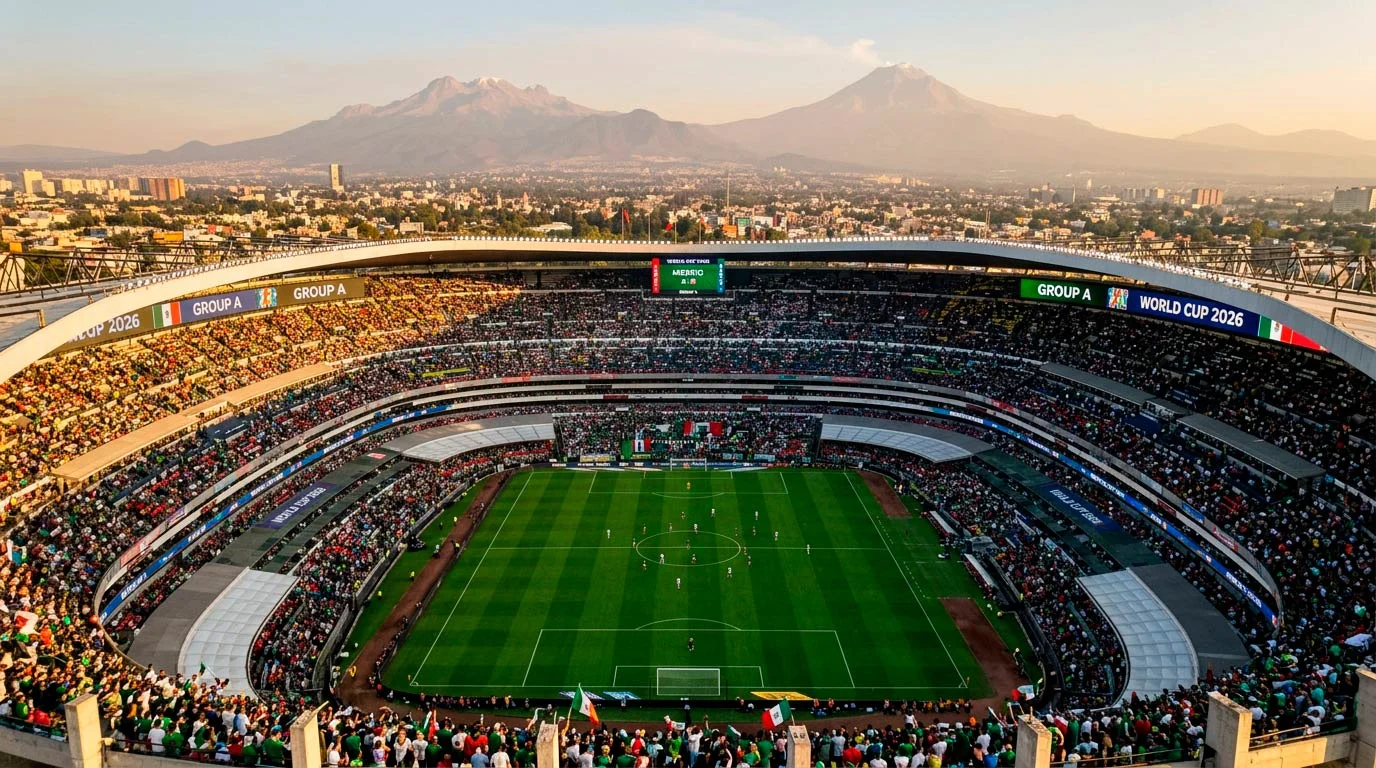
Every World Cup needs a curtain-raiser that sets the tone for weeks of football ahead, and on 11 June 2026, that responsibility falls squarely on Mexico’s shoulders. The opening match at Estadio Azteca – Mexico versus South Africa – is not just the first kick of the tournament; it is the first kick of the first 48-team World Cup in history, played in football’s most legendary stadium, in a city where altitude and atmosphere combine to create conditions unlike anything else in the sport. World Cup 2026 Group A carries the weight of that opening night plus three other nations fighting for survival in a format nobody has experienced before.
Hosting a World Cup should be an advantage. The data from the past six tournaments supports this – host nations have reached the knockout round every single time since 1998, and the average points per game for hosts in the group stage is 2.1 compared to 1.4 for all other teams. But Mexico’s hosting situation is unique. They share the tournament with the United States and Canada, which means the “home advantage” is distributed across three nations, and only three of the sixteen venues sit on Mexican soil. Still, Mexico play their opening match at the Azteca, their fans will travel in enormous numbers to every fixture, and the psychological lift of performing in front of your own people in a World Cup opener is worth more than any tactical adjustment.
Mexico’s squad for 2026 blends veterans of the 2022 Qatar campaign with a generation of young players who have broken through in Liga MX and European leagues over the past two years. The tactical setup under their current coaching staff favours a 4-3-3 with wide forwards cutting inside and a deep-lying playmaker who controls tempo. In CONCACAF qualifying, Mexico topped their group ahead of the United States and Canada, conceding just six goals in fourteen matches – the best defensive record in the confederation. Their weakness is familiar to anyone who has watched El Tri in recent World Cups: a tendency to start strong and fade under knockout-round pressure. In the group stage, though, Mexico are formidable, and Group A is a draw they should navigate comfortably.
South Korea qualified through the Asian zone in second place behind Japan, and their campaign told the story of a team in transition. The generation that powered the 2022 World Cup run – led by Son Heung-min, who will be 33 during the tournament – is giving way to a younger cohort of players who combine Korean football’s traditional work ethic with improved technical ability from early exposure to European academies. Son remains the talisman, but the creative burden is increasingly shared with Lee Kang-in and a cluster of midfielders who play in the Bundesliga and Serie A.
What makes South Korea dangerous in Group A is their pressing intensity. Over the past three World Cups, South Korea have ranked in the top five for distance covered per match, high-intensity sprints and pressing actions in the final third. Against Mexico, that energy could be the difference – if South Korea can sustain their press for 70 minutes and force turnovers in Mexico’s defensive third, the hosts’ composure will be tested in ways that CONCACAF qualifying never manages. The head-to-head record between these two nations is surprisingly balanced: six wins each and four draws in their last sixteen meetings across all competitions.
South Africa have not appeared at a World Cup since hosting the tournament in 2010, and their return to the global stage in 2026 is a story of resurgence that parallels New Zealand’s own journey. Bafana Bafana qualified through the African zone in a group that included Nigeria and Benin, finishing second behind Morocco’s dominant campaign. Their qualification was secured with a 1-0 victory over Benin in Johannesburg, and the celebrations that followed were reportedly visible from space – or at least from every television screen across the Southern Hemisphere.
South Africa’s squad features a core of players from the Premier Soccer League supplemented by a growing number of Europeans, notably in defence and midfield. Percy Tau provides experience in the forward line, and the defensive partnership that anchored qualification has conceded at a rate of 0.8 goals per match – impressive by any standard. For Group A, South Africa are the underdogs in every fixture, but they bring the kind of physical robustness and collective spirit that makes them a nightmare to play against in 30-degree heat with the Mexico City altitude draining legs around the 60th minute.
The fourth slot in Group A belongs to the winner of UEFA Playoff Path D, which features Czechia, Republic of Ireland, Denmark and North Macedonia competing in late March 2026. Each of these four teams brings a different challenge. Denmark reached the semi-finals of Euro 2024 and possess a squad with Premier League pedigree throughout. Czechia’s blend of technical midfielders and aggressive defending has been refined across two successful European Championship campaigns. The Republic of Ireland are physically imposing with a counter-attacking identity that travels well. North Macedonia are the outsiders but have proven they can upset favourites – their victory over Italy in World Cup qualifying for 2022 remains one of the decade’s biggest shocks.
For betting purposes, the playoff uncertainty creates a market inefficiency in Group A. TAB NZ has set provisional odds on Group A outcomes, but those odds will shift significantly depending on which team emerges from Path D. If Denmark qualify, they immediately become the second favourites in the group alongside South Korea. If Ireland or Czechia come through, the group becomes more balanced. If North Macedonia pull off another upset, Group A suddenly looks like Mexico’s to lose with three beatable opponents. Smart money waits for the playoff result before committing to Group A futures.
I have spent enough tournaments watching matches at inconvenient hours to appreciate when the schedule works in your favour. For New Zealand viewers, Group A delivers mixed news – the opening match falls during prime NZ afternoon viewing time, but subsequent fixtures shift depending on the host city’s time zone.
| Date | Match | Venue | NZT | ET |
|---|---|---|---|---|
| 11 June (Thu) | Mexico vs South Africa | Estadio Azteca, Mexico City | 12 June, 14:00 | 12:00 |
| 12 June (Fri) | South Korea vs UEFA PO D | Estadio BBVA, Monterrey | 13 June, 11:00 | 19:00 |
| 16 June (Mon) | Mexico vs South Korea | Estadio Azteca, Mexico City | 17 June, 14:00 | 22:00 |
| 17 June (Tue) | South Africa vs UEFA PO D | Estadio Akron, Guadalajara | 18 June, 11:00 | 19:00 |
| 21 June (Sat) | South Korea vs South Africa | Estadio BBVA, Monterrey | 22 June, 07:00 | 15:00 |
| 21 June (Sat) | Mexico vs UEFA PO D | Estadio Azteca, Mexico City | 22 June, 07:00 | 15:00 |
All Group A matches take place at the three Mexican venues – Estadio Azteca in Mexico City, Estadio BBVA in Monterrey and Estadio Akron in Guadalajara. This means every fixture in the group is played at altitude (Mexico City sits at 2,240 metres above sea level, Monterrey at 540m, Guadalajara at 1,566m), which disproportionately affects teams from lower-lying nations. South Korea train at sea level, South Africa’s domestic football is played at altitude in Johannesburg (1,753m), and European teams typically struggle to acclimatise within a standard tournament preparation window. Altitude is not just a geographical curiosity – it materially changes match outcomes, and Group A is the most altitude-affected group in the entire tournament.
The question I always ask before modelling group outcomes is: where are the points going to come from? In Group A, the answer is unusually clear. Mexico will beat the weakest team in the group (whichever that turns out to be), Mexico will likely beat or draw with South Africa, and Mexico’s only genuinely competitive fixture is against South Korea. If Mexico take seven points from three matches – two wins and a draw – they top the group with room to spare.
Second place is the battleground. South Korea’s pressing intensity and squad quality make them the natural candidates, but South Africa’s defensive organisation and physical resilience should not be underestimated. The head-to-head between South Korea and South Africa on Matchday 3 could be the decider, and I expect both teams to arrive at that fixture needing a result. In a 48-team format where the best eight third-placed teams also qualify, even the team that finishes third in Group A has a reasonable chance of advancing – provided they pick up at least three points and keep their goal difference above -2.
My baseline prediction: Mexico first, South Korea second, South Africa third with a realistic shot at advancing as a best third-placed team. The playoff winner finishes fourth unless Denmark emerge from Path D, in which case the group becomes significantly more competitive and the outcome less predictable. The beauty of the 48-team format is that three of four teams in every group have a genuine mathematical pathway to the knockout round – and Group A, with its balanced profile, is a group where that pathway is wider than most.
The last two tournaments taught me that group-winner markets are the worst place to find value in World Cup betting. The favourite tops the group roughly 55% of the time, but the odds rarely price them below 1.70, which means you are laying short prices for a coin-flip proposition. Where the value lives in Group A is in the match-level markets and the qualification props.
Mexico to win Group A is priced at approximately 1.55 on TAB NZ – a fair price but not a value bet. South Korea to qualify (top two) sits around 2.20, which I consider closer to fair value given their squad quality and tactical system. The angle I find most interesting is South Africa to qualify from the group at any price above 5.00. The 48-team format’s third-place route makes this a live proposition, South Africa’s defensive profile suits the conservative approach needed to accumulate points, and their altitude familiarity gives them a physical edge in every Mexican venue.
For individual matches, the opener – Mexico vs South Africa – deserves attention. Opening matches at World Cups are historically tight: the average goal margin in World Cup openers since 1998 is 1.1 goals, and the “under 2.5 goals” result has hit in five of the last seven opening fixtures. Mexico will be nervous, South Africa will be disciplined, the Azteca will be loud but intense pressure can paralyse as easily as it inspires. Under 2.5 goals in the opener is my strongest single-match pick for Group A.
Ask any neutral analyst to pick the single most entertaining fixture in Group A, and they will point to Matchday 2: Mexico versus South Korea at Estadio Azteca on 16 June. These two nations met at the 2018 World Cup in Russia, where South Korea’s pressing forced Mexico into errors that nearly cost them the match before El Tri recovered to win 2-1. They met again in a 2023 friendly where the scoreline was 3-2 in South Korea’s favour, with five goals coming from set pieces and counter-attacks – the two areas where both teams are most dangerous and most vulnerable.
The tactical matchup is compelling. Mexico’s possession-based 4-3-3 requires time on the ball in the middle third to function, and South Korea’s high press is specifically designed to deny that time. If South Korea can win the midfield battle in the first 30 minutes and force Mexico to play long, the hosts’ technical advantage evaporates. If Mexico weather the early storm and establish their passing rhythm, South Korea’s energy expenditure in the press leaves them exposed to quick transitions in the second half, when legs tire and concentration dips.
For bettors, both teams to score in this fixture looks like strong value. Mexico have scored in 17 of their last 20 competitive home matches, and South Korea have scored in 14 of their last 16 away fixtures. The tactical profiles create an open game with chances at both ends, and the altitude at the Azteca amplifies fatigue-driven defensive errors in the final 20 minutes. Both teams to score is priced at approximately 1.75 – I would take that at anything above 1.65.
Group A is the tournament’s opening act, and like any good opening act, its job is to set expectations for what follows. Mexico will provide the drama of a host nation performing under immense public pressure. South Korea will provide the intensity that Asian football has delivered at every recent World Cup. South Africa’s return after sixteen years mirrors the All Whites’ own story of patience and perseverance. And the UEFA playoff winner – whoever they are – will arrive with the momentum of having survived a four-team dogfight just weeks before the tournament begins. For NZ punters watching from across the Pacific, Group A offers the first betting opportunities of a 39-day marathon. Approach it with discipline, focus on the match-level markets, and remember that the first group to finish is rarely the one that defines your tournament profit. The smart money watches Group A, learns from it, and then applies those lessons to the eleven groups that follow.
