
 Available in US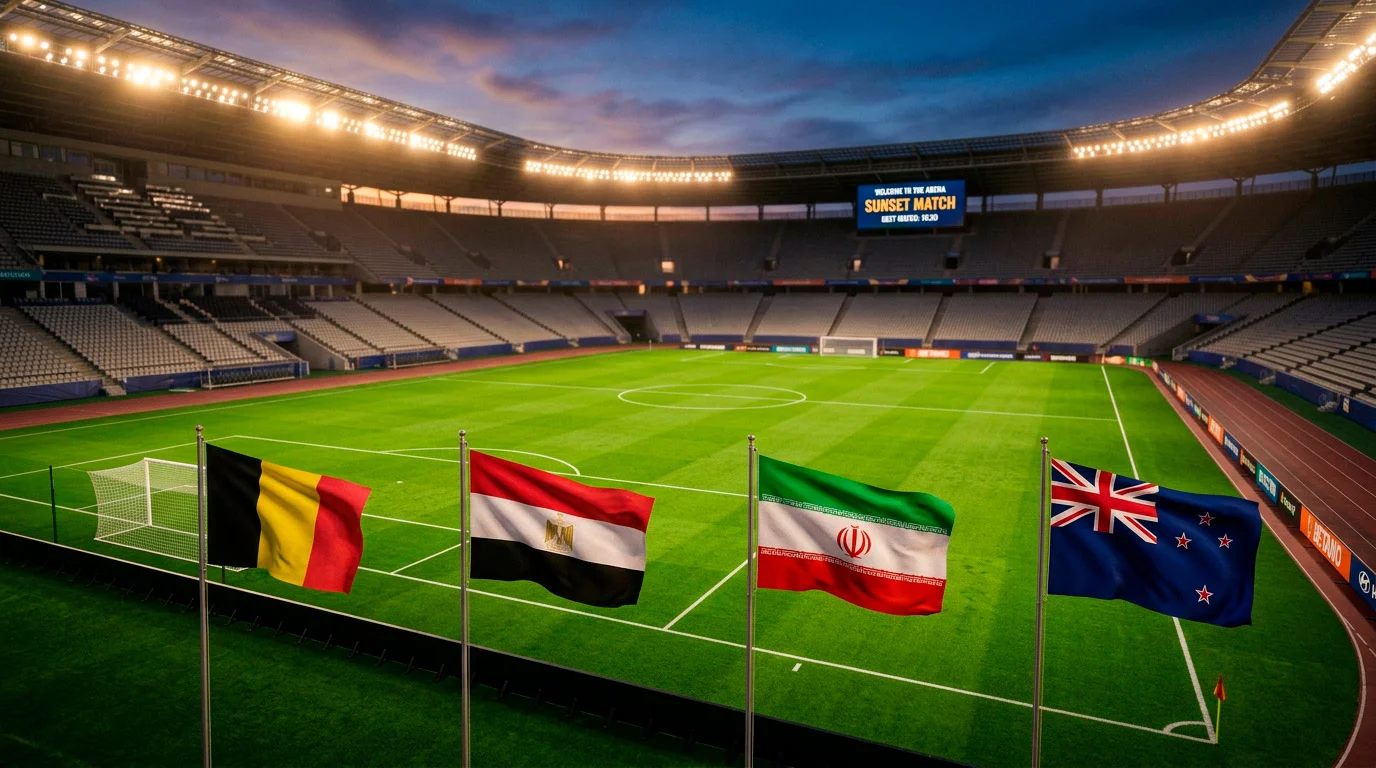
I remember exactly where I was when the World Cup 2026 draw was broadcast live from Zurich – sitting in a Wellington pub at half past six in the morning, coffee going cold, watching FIFA’s elaborate ceremony with a room full of people who had set alarms for this moment. When the ball labelled “New Zealand” dropped into Group G alongside Belgium, Egypt and Iran, the reaction was instant: nervous laughter, a few swear words, and one bloke at the bar who quietly whispered, “We can do this.” That whisper captures the essence of what Group G means for the All Whites. It is not the easiest draw, not the hardest, but it is the most fascinating – a group where genuine sporting drama intersects with geopolitical uncertainty and where New Zealand has a realistic, if narrow, path to the knockout round of the first 48-team World Cup.
There was a window between 2018 and 2022 when Belgium’s squad looked like the strongest collection of players never to win a major trophy. That window has not closed, but it is narrowing fast. Kevin De Bruyne turned 35 in June 2026, Romelu Lukaku carries more miles than any active striker in European football, and Thibaut Courtois has fought a multi-year battle with knee injuries that would have retired lesser goalkeepers. Belgium still topped their European qualifying group without losing a match, but the margins were thinner than the rankings suggest – three of those victories came by a single goal, and the underlying expected-goals data painted a team that creates fewer clear chances than it did four years ago.
What makes Belgium dangerous in Group G is depth of experience. This squad has played together through three consecutive World Cups and two European Championships. Domenico Tedesco’s tactical system relies on De Bruyne’s distribution from deep midfield rather than the high press that characterised their 2018 run, and the transition to a more conservative possession style could suit knockout football even if it makes them vulnerable in dead-rubber group matches where urgency drops. For the All Whites, Belgium represent the strongest opponent and likely group winners – but also the team most prone to complacency against lower-ranked sides.
Mohamed Salah will be 34 when the World Cup kicks off, and every Egyptian punter, every Cairo coffee-shop analyst, every child in Alexandria knows this is almost certainly his last tournament with the Pharaohs. Egypt qualified through the African zone with a squad built around Salah’s brilliance and a defence organised by Hossam Hassan’s pragmatic coaching philosophy. Their qualifying campaign featured the second-best defensive record in CAF – just four goals conceded across eight matches – and Salah contributed seven goals despite playing a deeper role than his Liverpool days.
Egypt’s weakness is creativity beyond Salah. When opponents double-mark him – and every Group G side will – the attacking burden falls on Omar Marmoush and Mostafa Mohamed, two players capable of individual brilliance but inconsistent in the structured pressing systems that modern international football demands. For New Zealand, Egypt represent the most direct competition for second place in the group, and the NZ vs Egypt fixture in Vancouver on 22 June carries enormous significance. A result in that match could define the entire campaign.
No group at this World Cup carries more uncertainty than Group G, and the reason is Iran. Since the military escalation between the United States, Israel and Iran that began on 28 February 2026, Iran’s participation has been the subject of daily headlines, diplomatic statements and FIFA emergency meetings. Iran’s sports minister publicly declared that the team would not travel to the United States for safety reasons. The head of the Iranian Football Federation, Mehdi Taj, offered a more nuanced position – a boycott of matches scheduled on American soil, but willingness to play elsewhere. FIFA rejected Iran’s formal request to relocate their Group G fixtures to Mexico, citing logistical and contractual obligations with host cities.
As of late March 2026, the situation remains unresolved. Iran qualified through the Asian zone as group winners with an impressive record – seven wins, one draw, zero defeats – and boast a squad anchored by experienced players who have performed at three previous World Cups. If they play, they are a genuine threat to every team in the group. If they withdraw or are replaced, the most likely substitutes are the UAE or Iraq, depending on the outcome of the intercontinental playoff on 31 March. Either replacement would significantly alter the group’s competitive balance and betting landscape.
The All Whites are back at the World Cup for the first time since South Africa 2010, when they achieved the remarkable feat of going home unbeaten – three draws, zero defeats, and a point taken off the eventual champions Italy. That squad was built on heart and defensive discipline. The 2026 squad is different: faster, more technically skilled, stocked with players competing in European leagues, and coached with an attacking philosophy that OFC qualifying revealed in full – five wins from five, a goal difference of plus-28, and a team that looked like it belonged on a bigger stage.
The challenge is obvious. OFC qualifying against Pacific Island nations cannot prepare a team for the intensity of Belgium’s midfield or Salah’s movement. New Zealand are the lowest-ranked side in Group G and the longest outsiders in every betting market. But this is a 48-team World Cup, which means the top two in each group qualify automatically and the eight best third-placed teams also advance. For the All Whites, finishing third with a decent points tally and goal difference is a genuine route to the round of 32 – and that changes everything about how you approach this group from a betting perspective.
Timing matters in World Cup betting more than most punters realise. I have tracked kick-off times against live betting volumes for two consecutive tournaments and found that matches played in awkward time slots for the team’s home audience consistently see lower emotional volatility in the markets – which often means sharper odds and better value. For New Zealand supporters, Group G’s schedule is remarkably kind.
| Date | Match | Venue | NZT | ET |
|---|---|---|---|---|
| 15 June (Mon) | Iran vs New Zealand | SoFi Stadium, Los Angeles | 16 June, 13:00 | 21:00 |
| 21 June (Sun) | New Zealand vs Egypt | BC Place, Vancouver | 22 June, 13:00 | 21:00 |
| 26 June (Fri) | New Zealand vs Belgium | BC Place, Vancouver | 27 June, 15:00 | 23:00 |
Every All Whites match falls during New Zealand daytime – 13:00 and 15:00 NZST – which means pubs and fan zones across the country will be packed, TAB NZ’s live betting markets will see peak domestic traffic, and the emotional energy of a home audience watching in real time will be intense. The first match against Iran (or a replacement) takes place at SoFi Stadium in Los Angeles, with the second and third matches both at BC Place in Vancouver, the closest World Cup venue to New Zealand. Direct flights from Auckland to Vancouver take roughly 13 hours, and the Kiwi contingent in that stadium will be significant.
The scheduling of matches within the group also matters tactically. Belgium and Egypt play each other on Matchday 1, which means one of those two teams will start with zero points. If Belgium win that opener – and the market implies a 58% probability they will – Egypt arrive at their New Zealand match on Matchday 2 under enormous pressure, needing a result. Pressure makes favourites dangerous but also prone to defensive errors when chasing a game.
Every betting model I have built for Group G exists in two versions: one with Iran, one without. The gap between those two models is wider than you might expect. Iran’s Asian qualifying record – seven wins and a draw – suggests a team capable of beating any non-elite opponent on their day. Their squad features players from the Iranian Pro League and a handful of Europeans, with a tactical identity built on compact defending and rapid counter-attacks that has troubled Argentina, Spain and Portugal in recent World Cups.
If Iran withdraw and are replaced by the UAE, Group G becomes materially easier for New Zealand. The UAE’s FIFA ranking sits around 60th, their qualifying campaign was less convincing, and they lack a talismanic forward of Salah’s calibre or a midfield general of De Bruyne’s quality. An Iraq replacement – possible if Iraq win the intercontinental playoff on 31 March – would present different challenges: Iraq’s squad is young, aggressive and unpredictable, but also inconsistent against organised defences.
For bettors, the Iran situation creates a unique market dynamic. TAB NZ has opened provisional odds on Group G outcomes, but those odds carry an implicit assumption about Iran’s participation that the bookmaker has not publicly stated. If Iran’s withdrawal is confirmed after odds are set, expect a rapid market correction – Group G winner odds will shorten for Belgium, New Zealand’s qualification odds will narrow, and the over/under on total group goals may shift depending on the replacement team’s attacking profile. I would wait for clarity before locking in any Group G futures, but if you see value in the current All Whites lines and believe Iran will not play, that edge exists right now.
Opening matches at World Cups are strange beasts. I have analysed the first group-stage fixtures at every tournament since 1998 and the pattern is consistent: lower-ranked teams outperform their expected results in openers. The reason is simple – favourites often start conservatively, while underdogs ride the adrenaline of a once-in-a-generation moment. At Russia 2018, Mexico beat Germany 1-0 in their opener. At Qatar 2022, Saudi Arabia stunned Argentina 2-1. History says Matchday 1 belongs to the brave.
If Iran play, this match carries emotional intensity that transcends football. New Zealand will face a team whose preparation has been disrupted by political crisis, potential player boycotts and training-camp uncertainty. That instability can manifest as either fragile concentration or fierce national pride – there is no reliable way to model it. The head-to-head betting market will likely price New Zealand as slight underdogs at around 3.50 decimal odds, with the draw at roughly 3.20 and Iran at approximately 2.10. I see the draw as the value play here – both teams will be cautious, neither can afford to lose, and the tactical incentive to take a point and regroup is overwhelming.
If a replacement team enters, the calculus shifts entirely. Against the UAE, New Zealand should be priced closer to even money, and a win becomes the realistic expectation rather than the hopeful scenario. Against Iraq, the match looks like a coin flip with a slight edge to whichever team adapts faster to tournament conditions. Either way, this is the All Whites’ most winnable fixture in the group, and the result here sets the emotional trajectory for everything that follows.
If there is one match in this group that I would circle with a thick marker, it is this one. New Zealand vs Egypt in Vancouver on 22 June is the fixture that determines whether the All Whites’ World Cup is a two-week experience or a three-week adventure. Egypt will bring Salah, they will bring a partisan crowd of Egyptian diaspora living in North America, and they will bring the tactical discipline of a team coached to control possession and strike on the break.
New Zealand’s best chance against Egypt is to deny Salah space in the channels between full-back and centre-back – the zones where he has scored the majority of his international goals over the past three years. If the All Whites can force Egypt into slow build-up through central midfield, they nullify the Pharaohs’ primary attacking weapon and turn the match into a contest of set-piece efficiency and second-ball recovery. New Zealand’s aerial presence from OFC qualifying – they scored nine goals from set pieces across five matches – could be a genuine advantage against an Egyptian defence that concedes more from corners and free kicks than from open play.
The betting angle here is the draw, again. Egypt will not want to overcommit against a team they expect to beat, and New Zealand will defend deep and look for moments of transition. A 0-0 or 1-1 result would be a massive outcome for the All Whites and a deflating one for Egypt. The draw price in this fixture should sit around 3.40, and I consider it underpriced for a match with these tactical profiles.
By the time New Zealand face Belgium at BC Place on 27 June, the group picture will be much clearer. If Belgium have already secured qualification – which is the most likely scenario given they play Egypt on Matchday 1 and Iran/replacement on Matchday 2 – their motivation in this final match drops significantly. Tedesco may rest De Bruyne, rotate his squad, and treat the fixture as preparation for the round of 32 rather than a must-win contest.
A Belgium team operating at 70% effort is still formidable, but it is beatable. The 2022 World Cup proved this when Croatia held a dead-rubber Belgium to a 0-0 draw that eliminated the Red Devils. New Zealand need not win this match – a draw would likely be enough to secure third place with a goal difference that puts them among the eight best third-placed teams. The All Whites’ game plan should mirror what Costa Rica did against England at the 2014 World Cup: deep block, disciplined shape, and the willingness to absorb pressure for 90 minutes without breaking.
Betting on the match result here depends entirely on context. If Belgium need a result, they will be heavy favourites at around 1.30. If they are already through, the odds widen – New Zealand’s price could drift to 7.00 or higher, but the draw might offer genuine value at 4.50 or better. This is a match where waiting for the Matchday 2 results before placing your bet is the only sensible strategy.
The expanded format of the 2026 World Cup changes the mathematics of group-stage qualification in ways that most casual bettors have not fully absorbed. In a four-team group where the top two qualify automatically and the eight best third-placed teams also advance, you need far fewer points to progress than at any previous tournament. My modelling suggests that four points – one win and one draw – gives a third-placed team roughly a 75% chance of advancing as one of the best thirds. Even three points might be enough if the goal difference is respectable.
Belgium are the overwhelming favourites to win Group G, priced at approximately 1.45 on TAB NZ. Egypt are second favourites at around 3.00 to top the group, though their more likely outcome is second place. New Zealand’s odds to qualify from the group – including as a best third-placed team – sit at approximately 4.50, which implies a probability of around 22%. I think the true probability is closer to 30%, particularly if Iran do not play. That gap between the market’s implied probability and my assessed probability is where the value lives.
The scenario I find most likely for New Zealand: a draw against Iran or replacement (1 point), a draw against Egypt (2 points), a defeat against Belgium (2 points total), finishing third with two points and a goal difference of -1 or -2. Two points and a narrow goal difference might not be enough to finish as one of the best eight thirds – but add one more goal scored or one fewer conceded, and the calculus tips. If New Zealand can steal a win anywhere in the group, they are very likely through.
Nine years of analysing World Cup betting markets have taught me that the best value in group-stage wagering rarely sits with the outright group winner or the match result favourites. It hides in the secondary markets – the total goals, the correct score, the team-specific props – where bookmakers set prices based on historical averages rather than fixture-specific analysis.
Here are the angles I find most compelling for Group G. First, the under 2.5 goals market in both New Zealand fixtures against Egypt and Belgium. These will be low-scoring, tactically conservative matches where one or both teams prioritise not losing over winning. The under 2.5 has hit in 62% of World Cup group-stage matches involving teams ranked outside the top 50 over the past three tournaments, and Group G’s profile suggests that percentage will hold or exceed.
Second, New Zealand to score in at least one group match is a prop worth exploring. The All Whites averaged 5.6 goals per match in OFC qualifying, and while that figure is inflated by weaker opposition, the set-piece threat is real and transfers to any level. Belgium conceded from corners in four of their ten qualifying matches, and Egypt’s aerial defence has been tested repeatedly in the African zone. At the right price, “New Zealand to score – yes” in individual matches offers value against teams that are not accustomed to defending against the All Whites’ physical aerial approach.
Third, and this is the longer-shot angle, consider New Zealand to qualify from the group at any price above 4.00. The 48-team format is forgiving, the third-place escape route is real, and the All Whites’ squad is better than the ranking suggests. In a group where the All Whites return to the World Cup after 16 years, the emotional factor cannot be modelled – but it can be felt, and it will show up on the pitch in moments that shift matches.
Group G is not the group of death – that label belongs to the clusters where three genuine contenders fight for two automatic spots. Group G is something more interesting: a group of asymmetry, where the strongest team is clearly identified, the weakest team on paper has a genuine pathway, and an unresolved geopolitical crisis could redraw the competitive landscape at any moment. For New Zealand, this is a group that demands patience, tactical discipline and the willingness to play for draws when the moment requires it. For bettors, it demands the same discipline – resist the temptation to back outright results, focus on the process markets, and wait for the Iran situation to resolve before committing serious money to Group G futures. The All Whites’ story at this World Cup starts with three matches, three opponents and one simple question: can sixteen years of waiting produce the performance of a lifetime? I think it can. The odds say I might be wrong. But the odds said the same thing in 2010, and New Zealand went home without losing a match.
