
 Available in US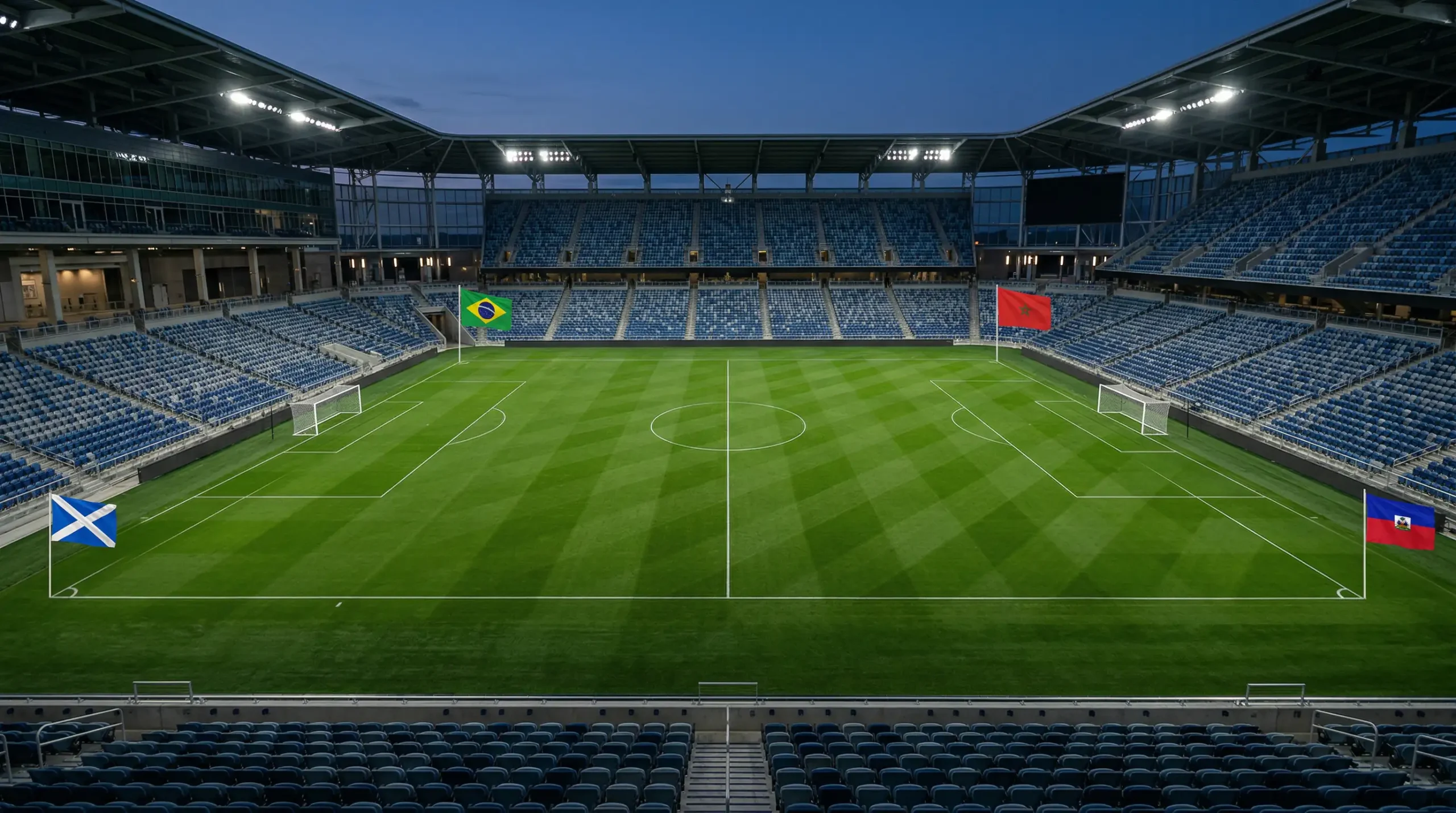
Four years ago in Qatar, Morocco stunned Brazil with a defensive masterclass in the quarter-finals that sent the five-time champions packing and launched the Atlas Lions into the semi-finals – the furthest any African nation had ever reached at a World Cup. FIFA’s draw algorithm, with its peculiar sense of drama, has placed these two teams in the same group again. World Cup 2026 Group C brings the rematch everybody wanted, a Scotland side desperate to prove they belong at the top table, and Haiti – a nation making its first World Cup appearance in 52 years, writing a chapter that transcends football entirely.
The Seleção have not won the World Cup since 2002. That sentence still looks wrong on the page, given that Brazil hold five titles – more than any other nation – and have historically treated World Cups as their personal showcase. But the 2026 squad carries the weight of that 24-year drought alongside the creative brilliance of a new generation led by Vinícius Jr., Endrick and Rodrygo. Brazil qualified through CONMEBOL in third place behind Argentina and Uruguay, a campaign marked by inconsistency under Dorival Júnior’s coaching tenure – brilliant victories against Colombia and Chile interspersed with frustrating home draws against Venezuela and Bolivia.
What defines Brazil’s 2026 profile is the tension between individual talent and collective organisation. Vinícius Jr. is arguably the most dangerous attacking player in world football, capable of single-handedly destroying defensive structures with pace and skill. Endrick, at just 19, has already scored 14 goals for Real Madrid this season and carries the kind of expectation that would crush lesser personalities. But Brazil’s midfield lacks the controlling presence of a prime Casemiro, and the full-back positions remain a source of debate among Brazilian analysts who cannot agree whether to prioritise attacking overlaps or defensive security. In Group C, Brazil’s talent should be enough to top the group, but the 2022 quarter-final exit against Morocco demonstrated that talent without tactical cohesion is not enough at this level.
Morocco’s run to the semi-finals in Qatar was not a fluke. The data confirmed what the eye test revealed: Walid Regragui built a team with the third-best expected-goals-against in the entire tournament, a pressing structure that ranks alongside the best European sides, and an attacking approach that relies on quick transitions rather than sustained possession. Four years later, the core of that squad remains intact – Achraf Hakimi, Hakim Ziyech, Youssef En-Nesyri – supplemented by younger players who have matured in the Spanish, French and English top divisions.
Morocco’s African qualifying campaign was dominant: eight wins from eight, 22 goals scored, three conceded. Their defensive organisation under Regragui has evolved from a reactive low block into a proactive high press that wins the ball in dangerous areas and converts turnovers into chances within three passes. For Group C, Morocco are the clear second favourites behind Brazil, and many analysts – myself included – believe the gap between these two teams is narrower than the odds suggest. The rematch of their 2022 quarter-final could easily determine which team tops the group, and Morocco have the tactical blueprint to beat Brazil again.
Scotland qualified for the 2026 World Cup through the European zone, finishing second in their qualifying group behind Spain. It is their first World Cup appearance since France 1998, a gap of 28 years that makes even New Zealand’s 16-year absence look brief. Steve Clarke’s squad is built around Premier League talent – John McGinn, Scott McTominay, Andrew Robertson – and a collective identity that prioritises work rate and tactical discipline over individual brilliance. Scotland’s qualifying record was solid: six wins, two draws and two defeats, with a goal difference of plus-eight that reflects their cautious, possession-averse style.
The challenge for Scotland in Group C is psychological as much as tactical. At Euro 2024 in Germany, Scotland froze in the opening match against the hosts – a 5-1 defeat that drained confidence and set the tone for a group-stage exit. Clarke’s task is to ensure that trauma does not repeat against Brazil, who represent an even more daunting first-day opponent. Scotland’s best chance in this group is to take points from Haiti and compete fiercely against Morocco in what projects as the decisive match for second place. A point against Brazil would be heroic. A win is improbable but not impossible – Scotland beat Spain in qualifying, and that result proved this team can perform above its ranking on the right day.
Haiti last appeared at a World Cup in 1974, when they travelled to West Germany and lost all three group matches, conceding 14 goals. The 2026 squad exists in a different reality. Haiti qualified through the CONCACAF zone by finishing fourth in the final round, ahead of Honduras and El Salvador, powered by a diaspora-driven squad that features players born and raised in France, the United States and Canada who chose to represent their parents’ homeland. Their leading scorer in qualifying, a forward who plays in Ligue 2, scored seven goals in twelve matches – a remarkable return for a team that most CONCACAF analysts had written off before the campaign began.
Haiti’s presence in Group C adds a narrative dimension that no other group in the tournament can match. This is a nation that has endured devastating earthquakes, political instability and an infrastructure deficit that makes organised football development almost miraculous. The squad’s story is one of identity, diaspora and the power of sport to represent something larger than results on a pitch. On the pitch, Haiti are the clear underdogs – they will struggle against Brazil’s pace, Morocco’s pressing and Scotland’s physicality. But the 48-team format gives them a mathematical chance of finishing third with enough points to advance, and in a group where Brazil and Morocco are likely to beat everyone, Haiti’s points will come from one fixture: Scotland. That match could define Haiti’s entire World Cup experience.
The fixture schedule for Group C is structured to deliver maximum drama on Matchday 2, when Brazil face Morocco in the most anticipated group-stage rematch of the tournament. For New Zealand viewers, the timing is mixed – early-morning and midday kick-offs dominate, depending on which US venue hosts each match.
| Date | Match | Venue | NZT | ET |
|---|---|---|---|---|
| 12 June (Fri) | Brazil vs Scotland | Hard Rock Stadium, Miami | 13 June, 13:00 | 21:00 |
| 13 June (Sat) | Morocco vs Haiti | Mercedes-Benz Stadium, Atlanta | 14 June, 10:00 | 18:00 |
| 17 June (Tue) | Brazil vs Morocco | Hard Rock Stadium, Miami | 18 June, 13:00 | 21:00 |
| 17 June (Tue) | Scotland vs Haiti | Mercedes-Benz Stadium, Atlanta | 18 June, 07:00 | 15:00 |
| 22 June (Sun) | Brazil vs Haiti | NRG Stadium, Houston | 23 June, 07:00 | 15:00 |
| 22 June (Sun) | Morocco vs Scotland | Mercedes-Benz Stadium, Atlanta | 23 June, 07:00 | 15:00 |
The Matchday 3 fixtures – Brazil vs Haiti and Morocco vs Scotland – are scheduled simultaneously, which means the final group standings will be decided in real time with no team able to calculate their result based on another match’s outcome. This simultaneous kick-off format, introduced by FIFA after the 1982 “Disgrace of Gijón,” is particularly important in Group C because the Morocco vs Scotland match is likely to determine second place. If Morocco have already beaten Haiti and taken at least a draw against Brazil, Scotland need a result in Atlanta to have any chance of advancing.
Group C splits cleanly into two tiers. Brazil and Morocco are the strong pair; Scotland and Haiti are the weaker pair. The primary question is not whether Brazil and Morocco advance – both almost certainly will – but which one finishes first and which finishes second. Group position matters because it determines the round-of-32 opponent, and the difference between facing a weak third-placed team and a strong group runner-up is significant.
My model gives Brazil a 62% probability of topping the group, Morocco 30%, Scotland 6% and Haiti 2%. Those percentages shift if we weight the Brazil-Morocco head-to-head more heavily based on their 2022 meeting, which Morocco won through defensive discipline that Brazil could not break. I expect Brazil to approach the rematch with a revised tactical plan – more patient build-up, less reliance on Vinícius running at Hakimi one-on-one – but whether Dorival Júnior can execute that plan against a Regragui defence is another matter entirely.
For second place, Morocco hold the advantage unless Scotland can produce a result against them on Matchday 3. Scotland’s path to the knockout round most likely runs through finishing third with four points – beating Haiti, drawing with Morocco, losing to Brazil – and qualifying as one of the eight best third-placed teams. That scenario requires Scotland to manage their goal difference carefully, because a heavy defeat against Brazil could undo the good work from their other two matches. Haiti’s most likely outcome is zero points, but the margin of their defeats matters for their own pride and for the goal-difference calculations of the teams above them.
The outright Group C winner market on TAB NZ prices Brazil at approximately 1.40 – one of the shortest group-winner prices in the entire tournament. That price implies a 71% probability, which is nine percentage points higher than my model’s assessment. I see no value in backing Brazil to top the group at that price. Morocco to win Group C at roughly 3.50 is far more interesting – it implies a 29% probability, which aligns closely with my model, meaning the bet is approximately fair value rather than a clear edge, but the 2022 precedent gives Morocco a qualitative advantage that statistical models underweight.
The strongest value play I see in Group C is Morocco to qualify (top two finish) at approximately 1.60. Morocco’s squad is deep, their tactical system is proven at World Cup level, and the group contains no opponent capable of matching their combination of defensive organisation and transition speed except Brazil. Scotland to qualify from the group at approximately 4.00 also deserves consideration – the third-place route makes this a live proposition for any team that can collect four points, and Scotland’s squad has the quality to beat Haiti and compete with Morocco.
For match-level bets, I like under 2.5 goals in Brazil vs Morocco on Matchday 2. Their 2022 encounter finished 1-0, and both teams approach this fixture with defensive respect for each other. Morocco will sit deep and counter; Brazil will probe patiently. The match profile screams low-scoring, and the under 2.5 should be priced at around 1.90 – good value for a bet that has hit in four of the last five competitive meetings between South American and African nations at World Cups.
If I could attend only one group-stage match at this entire World Cup, it would be Brazil versus Morocco in Miami on 17 June. Not because it will necessarily be the highest-quality football – that honour might belong to Argentina vs France if the bracket produces it – but because the narrative layers are unmatched. Morocco eliminated Brazil from the last World Cup with a performance that shattered assumptions about the hierarchy of world football. Brazil have spent four years stewing on that defeat, rebuilding their squad and promising a response. The rematch at Hard Rock Stadium is not just a football match; it is a referendum on whether 2022 was a one-off upset or a permanent shift in the balance of power.
Tactically, the matchup is chess at its finest. Regragui will deploy the same defensive structure that suffocated Brazil in Qatar – a compact 4-1-4-1 that invites pressure, denies space between the lines and relies on Hakimi’s pace to launch counter-attacks down the right flank. Brazil’s response will likely involve Vinícius Jr. operating centrally rather than wide, Endrick providing a physical presence in the box, and a midfield triangle designed to overload Morocco’s single pivot. The key battle is in the half-spaces – the zones between Morocco’s centre-backs and full-backs where Brazil’s inside forwards want to receive and turn.
For neutral bettors, the draw in this match at approximately 3.20 represents strong value. Both teams know that a draw preserves their qualification pathway, both teams respect the other’s quality, and neither team wants to lose a match that would hand the opponent a psychological advantage heading into the knockout rounds. The 0-0 correct score at roughly 7.00 is a long-shot punt worth a small stake, given the defensive profiles involved. Whatever happens, Brazil vs Morocco will be the group-stage match that everybody talks about – and the result will reverberate through the bracket all the way to the knockout round draw.
Group C offers everything a football supporter could want: the world’s most decorated football nation chasing a record-extending sixth title, the team that humiliated them four years ago looking to prove it was no accident, a proud European side making their World Cup return after nearly three decades, and a Caribbean nation whose presence represents one of the most unlikely qualifying achievements in the tournament’s history. For NZ punters, Group C provides early-tournament betting opportunities in a group with clear favourites and identifiable value in the secondary markets. For football lovers, it provides stories that will outlast the results. Watch Brazil vs Morocco on Matchday 2, monitor Scotland’s battle for third place on Matchday 3, and spare a thought for Haiti – because every now and then, football reminds us that the scoreline is the least important part of the story.
